

What is Design Thinking & Why Should You Care?
Introduction
Early glimpses of design thinking date back to the 1950s and 1960s, although these references were more within the context of architecture and engineering — fields which struggled to grapple with the rapidly changing environment of that era. Even though Design Thinking has been around for a while, its market size is still expected to grow significantly according to Verified Market Reports. So what is Design Thinking and why should you care?

What is Design Thinking?
Design Thinking is a mindset and approach to problem-solving and innovation anchored around human-centered design. While it can be traced back centuries—and perhaps even longer—it gained traction in the modern business world after Tim Brown, CEO and president of design company IDEO, published an article about it in the Harvard Business Review.
Design Thinking is different from other innovation and ideation processes in that it’s solution-based and user-centric rather than problem-based. This means it focuses on the solution to a problem instead of the problem itself.
The essence of Design Thinking is human-centric and user-specific. It’s about the person behind the problem and solution, and requires asking questions such as “Who will be using this product?” and “How will this solution impact the user?”
The first step of Design Thinking is building empathy with users. By understanding the person affected by a problem, you can find a more impactful solution. On top of empathy, Design Thinking is centered on observing product or service interaction, drawing conclusions based on research, and ensuring the user remains the focus of the final solution.
Design Thinking Phases
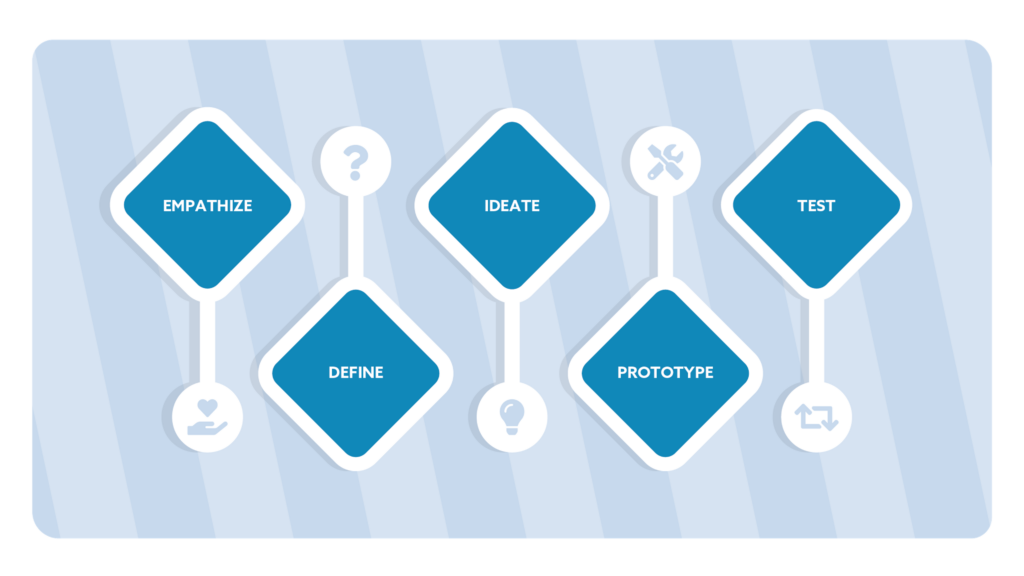
During the Empathize phase you set aside your own biases and work to gain a deeper understanding of the real users and their needs. This is done through direct observation and engagement.
The Define phase is about defining the problem. In this phase, you analyze the data gathered during the previous phase to identify and define the issue with a clear and concise problem statement.
During the Ideate phase you start to explore solutions. Ideas in this stage will ultimately become prototypes that can be tested with your target audience.
The Prototype phase of Design Thinking you create prototypes of the ideas you generated in the previous phase. Prototypes don’t need to be finished products. They are meant to convey a possible solution, not to deliver it. Sketches, models, and digital renders are all examples of prototypes: scaled-down versions of the product created during the ideation phase.
The Test phase involves real users and real user feedback. During this phase, prototypes are given to participants to try out. You observe how participants interact with the prototype and gather feedback about the experience.
Eventually, you choose the most viable and valuable solution(s) based on the information that you have acquired throughout the Design Thinking phases.
Why Should You Care?
Why is design thinking needed, you may ask? Innovation is defined as a product, process, service, or business model featuring two critical characteristics: novel and useful. Yet, there’s no use in creating something new and novel if people won’t use it. Design Thinking offers innovation the upgrade it needs to inspire meaningful and impactful solutions.
Following a Design Thinking methodology makes you think outside of the box. Design Thinking can help people do out-of-the-box or outside-the-box thinking. People who use this methodology:
- Attempt to develop new ways of thinking—ways that do not abide by the dominant or more common problem-solving methods.
- Have the intention to improve products, services and processes. They seek to analyze and understand how users interact with products to investigate the conditions in which they operate.
- Ask significant questions and challenge assumptions. One element of outside-the-box / out-of-the-box thinking is to to make previous assumptions falsifiable—i.e., make it possible to prove whether they’re valid or not.
As you can see, Design Thinking helps you carry out the right kind of research, create prototypes and test our products and services to uncover new ways to meet our users’ needs.
Why Do Design Thinking Skills Matter?
The main value of Design Thinking is that it offers a defined process for innovation. While trial and error is a good way to test and experiment what works and what doesn’t, it’s often time-consuming, expensive, and ultimately ineffective. On the other hand, following the concrete steps of Design Thinking is an efficient way to develop new, innovative solutions.
On top of a clear, defined process that enables strategic innovation, Design Thinking can have immensely positive outcomes for your career—in terms of both advancement and salary. In July 2024, just on Indeed, an employment website, it listed 30,000+ job openings with Design Thinking skills requirements.

According to Verified Market Reports, the Design Thinking Market size was valued at USD 7.82 Billion in 2023 and is projected to reach USD 10.85 Billion By 2030, growing at a CAGR of 7.1% during the forecast period 2024 to 2030. It states that technological improvements and changing consumer expectations are causing dynamic shifts in the global Design Thinking market. Examples of these shifts are:
The growth driving factors of the global Design Thinking Market are:
What is Worth Remembering?
First and foremost, Design Thinking is for everybody. Design Thinking is not only for designers but also for creative employees, freelancers and leaders who seek to infuse it into every level of an organization. This widespread adoption of Design Thinking will drive the creation of alternative products and services for both business and society.
Furthermore, Design Thinking is not just for everybody—it’s about everybody, too. It is human-centric. The process is firmly based on how you can generate a holistic and empathic understanding of the problems people face. Design Thinking involves ambiguous, and inherently subjective, concepts such as emotions, beliefs, needs, motivations, and drivers of behavior.
What is Design Thinking & Why Should You Care? The answers provided in this blog speak for themselves. It is a must-have skills that is in high demand. A skill that will set you apart through innovative products and services that are the result of applying the methodology. DTMethod© is a proven Design Thinking methodology. It comes with certification training courses, coaching and workshops to support the application of Design Thinking, and an slew of practical application guidance in the form of rules, roles, processes, and tools.