Design Thinking and Project Management
Introduction
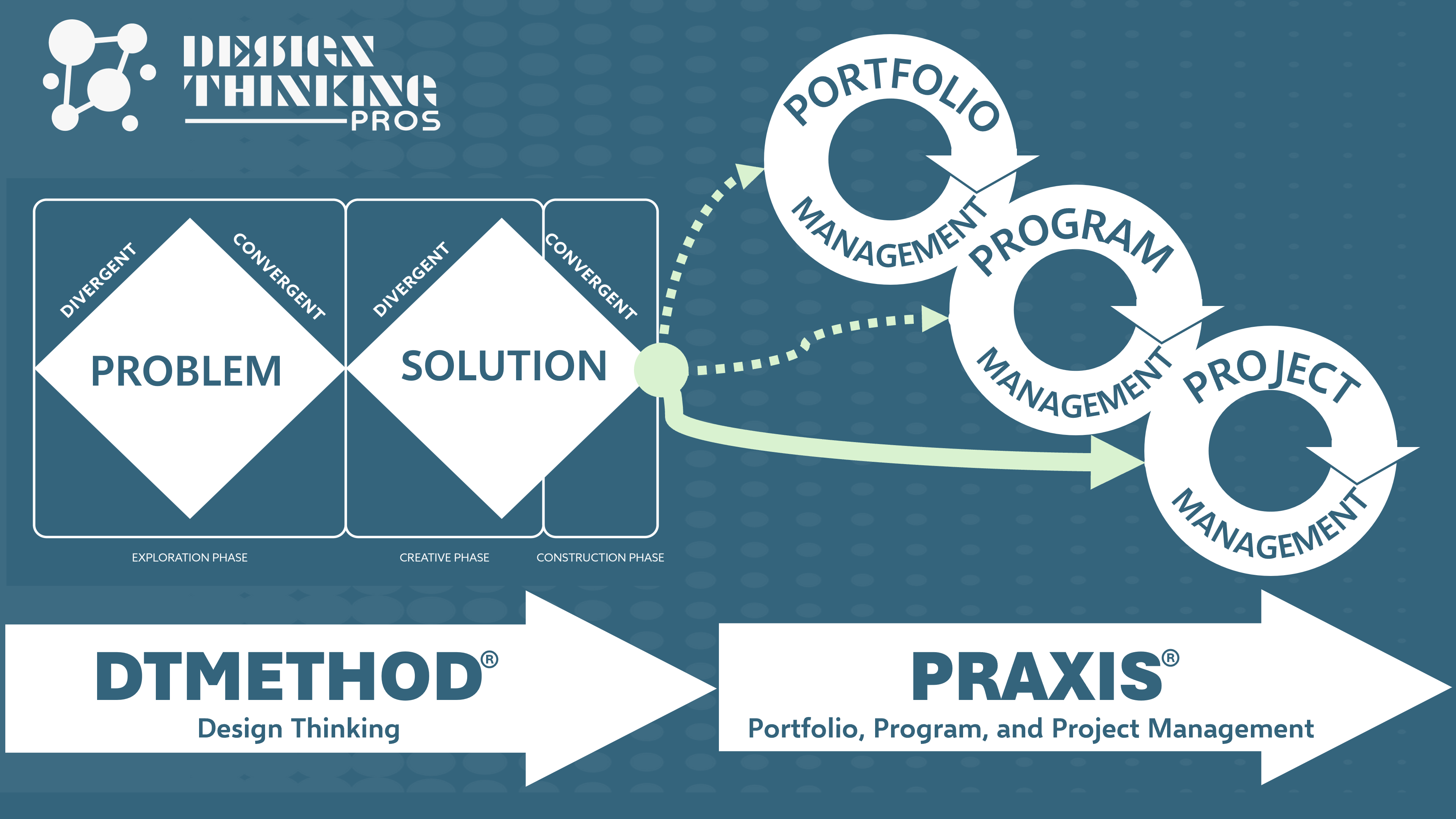
Sometimes, when talking about the design thinking methodology, DTMethod©, people wonder what to do next. What should be the next steps after developing, with or without your DTMethod© coach, a ready-to-use solution that was the result of applying DTMethod©? How to transform an advanced prototype into something that we want to give to customers “instantly” through project management? How to ensure that our ideas do not get stuck only at the Design Thinking stage. In other words, how to best go about integrating design thinking and project management?
The answer to such questions is to use various Project Management methodologies. For example Praxis©, which should be the next step after Design Thinking.

Project Management – the Next Stage of Introducing a Product and Service to the Market
The solution we develop while practicing Design Thinking, is the response to the Challenge that was posed. This solution will then have to be implemented, which is the domain of project management. Projects focus on creating new things – products, services, which the organization implements for the first time. They have a clear beginning and end and involve people who play specific roles in the implementation of the project. When describing projects, it is impossible not to mention the basic division of their implementation method. We distinguish traditional and agile approaches to project management.
Traditional project management approaches, think traditional waterfall, focus on very precise description of the solution. From the very beginning of its creation, to the reliable delivery of what was established at the start. A traditionally managed project, in which we agree to create a solution, we ensure that at all costs are clear. And that a solution will be delivered accordingly.
In agile project management approaches, the solution that is to be created is not very precisely defined from the beginning. We rather set a certain direction and define what a minimum must be delivered. We know where we are heading and what we need to achieve. The priority will be that the work is on time or within budget. Even if it means creating only the core of the solution. In many cases, this means that some functions or features will have to be abandoned. And frequent contact with the client will be necessary.
Agile, or How and Why?
When finishing the agile development of a solution resulting from Design Thinking, the transition to an agile project is a typical next step.
Iterative improvement of the solution through loops of prototyping and testing, re-prototyping and testing again, can imperceptibly transition into agile solution delivery. During the short time cycles in which we work (i.e. timeboxes), continuous contact with the client, and stakeholder involvement is typical for both design thinking and agile project management. This way of working works especially well where the solution that we create does not have a single, easy-to-define solution from the beginning.
Is it Really Necessary to Reject Tradition?
Obviously, there is nothing that stops you from moving straight from the Design Thinking process to projects managed in a traditional way. The basic difference will be that the solutions developed within Design Thinking will need to be described in great detail. In such a situation, it is worth involving people who participated in the Design Thinking process in the project. These people have the most complete knowledge about the solution that is to be created. They will be able to specify very precisely what a given solution is about. Such knowledge will be especially useful in the initial stages of the project, when defining the scope of the project.
You Don’t Have To Change the Entire Organization
If your organization does not follow a proven project management method, Design Thinking is still of value to you. You don’t necessarily have to change the entire organization to use Design Thinking.
Regardless of the methodology you follow (or not), and regardless whether you follow a traditional project management method or an agile approach – at the start of each project, you determine what needs to be done. So whenever the organization faces the challenge of creating something new and does not know how to go about it, you can use Design Thinking.
Additionally, regardless of the chosen project management methodology, there are problems that universally plague all teams everywhere. Everyone probably knows of a situation in which poor communication in the team makes it nearly impossible to work. Design Thinking is great at streamlining processes in the organization. When project teams face difficulties related to communication or work organization – in these situations, Design Thinking can also come to the rescue.