
Leadership Wisdom: Reimagining Portfolios in Uncertain Times
Economic downturns have historically been catalysts for innovation. The companies that emerged strongest from the 2008 recession weren’t those that slashed indiscriminately – they were organizations that strategically reallocated resources toward future growth while remaining true to their core purpose.

1. Start with Strategic Reprioritization
Assess what truly matters now. Revisit your organization’s mission-critical goals. Ask: Which programs directly support our most pressing outcomes? Which initiatives have measurable impact and clear alignment to today’s reality?
Lead a value-based review. Consider cost, risk, timing, and value delivery—not just in financial ROI but in customer, operational, or brand value.
Pause or sunset lower-impact efforts. Cutting cost doesn’t mean cutting vision—it means refining it.
Historic Lesson:
After the dot-com crash, Amazon survived by doubling down on customer-centricity while rigorously cutting non-essential spending. Their leadership didn’t abandon innovation – they focused it on their core value proposition of selection, convenience, and price.
2. Use Design Thinking to Ensure Funds Are Well-Spent
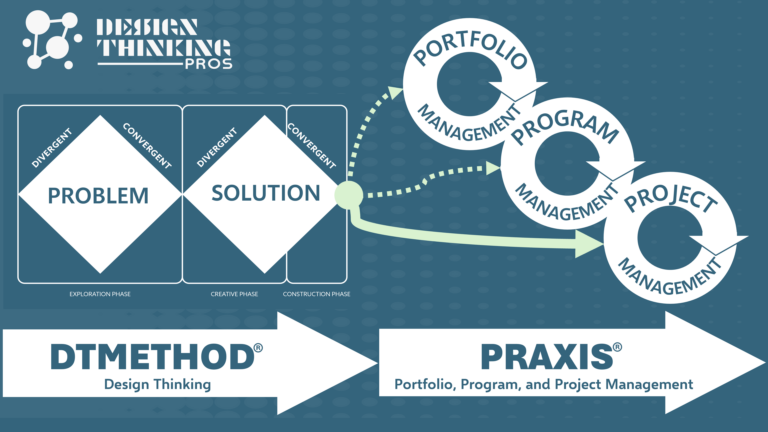
Design Thinking isn’t just for product teams—it’s a leadership approach to innovation with empathy and clarity (for example: DTMethod®). Use it to make better investment decisions:
Empathize – In uncertain times, customer and employee needs shift dramatically. Go beyond surveys to conduct deep listening sessions. What pain points have intensified? What new anxieties or practical challenges have emerged? This empathetic foundation ensures you’re solving relevant problems.
Define – Reframe challenges as opportunities. Instead of “How do we cut 20% of costs?” ask “How might we deliver our core value more efficiently?” This subtle shift transforms cost-cutting from a reactive exercise to a creative challenge.
Ideate – Bring diverse perspectives together – operations, finance, customer support, and frontline teams often see opportunities invisible to leadership. Create psychological safety so bold ideas can emerge.
Prototype – Create minimal viable versions of initiatives to test assumptions. A two-week pilot project can reveal more than months of planning meetings.
Test – Measure ruthlessly against customer value and financial impact. Be willing to kill even promising ideas if the numbers don’t support scaling.
💡 Design Thinking gives leaders a way to fund ideas with evidence—not just hope.
Design Thinking in Action:
During the 2020 pandemic, restaurant chain Chipotle rapidly prototyped digital-first experiences, testing new service models before competitors could react. Their “Chipotlanes” (drive-through pickup lanes) weren’t a cost-cutting measure – they were a reimagined customer experience that happened to be more efficient.
3. Establish a Portfolio Governance Framework
Create a clear rubric for decision-making: What criteria must each project meet? This can include:
- Strategic alignment
- Financial impact
- Risk mitigation
- Equity and stakeholder benefit
- Scalability and adaptability
Use a scoring model to help guide unbiased prioritization.
Implementation Insight:
The most effective portfolio reviews operate with “sacred cows hunting licenses” – nothing is exempt from scrutiny, not even the CEO’s pet projects. This requires courage but ensures decisions are made on merit, not politics.
4. Engage Teams in Reimagining Value
This is a time to engage cross-functional teams, not just execs. Host Design Thinking sessions or mini-jams where teams reframe solutions that cost less but deliver more impact. Give permission to reimagine—not just reduce.
Leadership Story:
When IBM faced existential challenges in the 1990s, Lou Gerstner didn’t just cut – he engaged thousands of employees in reimagining the company’s future, ultimately pivoting from hardware to services. The wisdom wasn’t just at the top; it was distributed throughout the organization.
5. Lead with Transparency and Optimism
Communicate the why behind changes. Celebrate smart cost-savings, not just budget cuts. Frame this moment not as a contraction—but as a realignment for resilience and innovation.
Psychological Insight:
Research shows that organizations experiencing cost pressure often fall into “threat rigidity” – becoming more hierarchical and risk-averse precisely when they need creativity. Great leaders counteract this by creating psychological safety and maintaining a growth mindset even while making difficult decisions.
6. Implement Portfolio Rhythm and Rituals
Economic uncertainty requires more frequent portfolio review cycles:
- Move from annual to quarterly portfolio reassessments
- Create “fast-track” decision paths for time-sensitive opportunities
- Establish clear, consistent communication cadences about portfolio changes
- Build in learning reviews to continuously refine your approach
Tactical Approach:
Institute a “10/10/10 rule” – spend 10 minutes daily reviewing one project’s status, 10 hours monthly reassessing portfolio balance, and 10 days quarterly for deep strategic realignment.
7. Balance the Portfolio Horizons
Even in cost-cutting environments, maintain investments across three horizons:
- Horizon 1: Core business optimization (70% of resources)
- Horizon 2: Emerging opportunities (20% of resources)
- Horizon 3: Future-focused experiments (10% of resources)
Historical Warning:
Companies that eliminated all future-focused investment during past downturns took, on average, 3-5 years longer to recover than those that maintained a balanced portfolio approach.
Pro Tips:
The Path Forward
Economic uncertainties will always challenge leadership teams. By combining strategic clarity with design thinking approaches, you transform these moments from survival exercises into opportunities for meaningful reinvention.
The organizations that thrive won’t just be those that managed costs effectively – they’ll be the ones that reimagined how to deliver value in fundamentally better ways.
What portfolio decisions will you make today that your future self will thank you for?
Contact us for a free consultation to explore your options to also start benefiting from design thinking per DTMethod® or portfolio management per Praxis®.