While different design thinking methodologies may use varying terminology, most follow similar core phases. Let’s explore these phases in detail to understand how they contribute to successful innovation and problem-solving.
Understanding the Phases
Let’s go over the typical design thinking phases, one at a time:
1. Empathy/Research Phase
Activities
Key Artifacts
Stakeholders
User interviews and observations
Stakeholder mapping
Contextual inquiry
Survey research
Competitive analysis
Market research
Interview transcripts
User journey maps
Empathy maps
Research synthesis documents
Observation notes
Personas
End users
Subject matter experts
Business stakeholders
Research team
Design team
Tips
Common Pitfalls
Focus on understanding rather than solving
Observe what people do, not just what they say
Document everything, including non-verbal cues
Stay neutral and avoid leading questions
Rushing to solutions
Relying only on surveys
Interviewing too few users
Confirming existing biases
2. Define/Synthesis Phase
Activities
Key Artifacts
Stakeholders
Pattern identification
Problem framing
Insight development
Opportunity mapping
Priority setting
Problem statements
How Might We questions
Insight clusters
Opportunity matrices
Design principles
Design team
Project sponsors
Business analysts
Subject matter experts
Tips
Common Pitfalls
Frame problems as opportunities
Use clear, action-oriented language
Focus on user needs, not technical solutions
Validate problem statements with stakeholders
Making assumptions
Being too broad or too narrow
Jumping to solutions
Ignoring business constraints
3. Ideation Phase
Activities
Key Artifacts
Stakeholders
Brainstorming sessions
Concept development
Idea prioritization
Solution mapping
Creative workshops
Idea boards
Concept sketches
Solution prioritization matrices
Innovation portfolios
Workshop documentation
Cross-functional teams
Innovation leads
Technical experts
Business stakeholders
End users (for co-creation)
Tips
Common Pitfalls
Defer judgment during brainstorming
Build on others’ ideas
Encourage wild ideas
Use visual thinking
Self-censoring
Focusing only on feasible ideas
Allowing criticism during ideation
Not building on others’ ideas
4. Prototyping Phase
Activities
Key Artifacts
Stakeholders
Rapid prototyping
Concept visualization
Experience simulation
Technical feasibility assessment
Cost estimation
Paper prototypes
Digital mockups
Service blueprints
Experience prototypes
Technical specifications
Design team
Development team
Technical experts
End users
Business stakeholders
Tips
Common Pitfalls
Start low-fidelity and iterate
Focus on learning
Create just enough detail
Plan for multiple iterations
Over-polishing too early
Testing too many variables at once
Not documenting feedback
Being too attached to solutions
5. Testing/Validation Phase
Activities
Key Artifacts
Stakeholders
User testing
Feedback collection
Iteration planning
Implementation preparation
Success metrics definition
Test plans
Feedback logs
Iteration roadmaps
Implementation plans
Success metrics
End users
Testing team
Development team
Business stakeholders
Project sponsors
Tips
Common Pitfalls
Test with real users
Focus on behavior, not opinions
Document all feedback
Plan for iterations
Leading users during testing
Defending instead of listening
Not testing with diverse users
Ignoring negative feedback
The DTMethod Approach
While the phases above represent traditional design thinking approaches, the DTMethod offers a unique and streamlined approach to innovation and problem-solving. Building on these fundamental phases, DTMethod introduces specialized tools and frameworks that help organizations move more efficiently through the design thinking process while maintaining rigor and effectiveness.
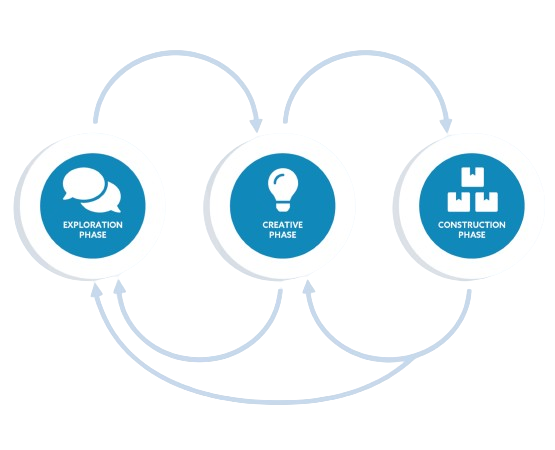
Design Thinking Process
DTMethod introduces a simplified approach and includes tools and techniques for each of the phases in support of producing the artifacts.
Ready to Learn More?
Understanding these phases is just the beginning. If you’re interested in learning how the DTMethod can help your organization implement design thinking more effectively, we’d love to have a conversation.
Let’s discuss:
Your organization’s specific innovation challenges
How DTMethod can be tailored to your needs
Case studies from similar organizations
Next steps for implementing design thinking
Contact us to schedule a consultative conversation about how we can help transform your organization’s approach to innovation and problem-solving. Our calendaring feature allows for scheduling a 30-minute Zoom meeting at a day and time that is convenient for you. Or simply send us a message. Let’s explore how DTMethod can help your organization innovate and grow.