Individual & team Coaching
Complement your DTMethod®, Praxis®, and AIPM Training with an individual or team coach to ensure that every innovative investment pays off.
As Warren Buffett once taught us, investing is simple, but not easy.
Hire Your Individual or Team DTMethod®, Praxis®, or AIPM Coach Today
Choose from one of the following DTMethod®, Praxis®, or AIPM Coaching Programs
and establish a thriving innovative culture across your organization.
Your Guide To Greatness
Sometimes you just need that additional nudge to guide you where you want to be.
DTMethod® Coaching
– Personalized guidance
– Evolve your competencies and skills such as empathy, problem framing, ideation, prototyping, iteration, visual thinking, collaboration, user research, synthesis, critical thinking, facilitation, storytelling, experimentation, systems thinking, successfully operationalizing DTTools, optimally implementing DTRules, effectively assigning DTRoles, and observation of results and impacts
– Custom expert topics
PRAXIS® Coaching
– Personalized guidance
– Evolve your competencies and skills such as planning & scheduling, risk management, budgeting & cost control, stakeholder management, team leadership, communication, problem-solving, time management, quality management, resource allocation, negotiation, adaptability, conflict resolution, performance monitoring, documentation, procurement management and change management
– Custom expert topics
AIPM Coaching
– Personalized guidance
– Evolve your competencies and skills in AI-enhanced planning & scheduling, intelligent risk management, automated budgeting & cost control, AI-powered stakeholder management, data-driven team leadership, AI-assisted problem-solving, optimized time management, predictive quality management, intelligent resource allocation, real-time performance monitoring, and AI-driven procurement management
– Custom expert topics
Most popular choice
individual dtmethod® coaching
1 person
$250 / month
*billed annually
*one session / month
*live online
o
Team dtmethod® coaching
2-12 persons
$199 / person
*billed annually
*one session / month / person
*live online
Most popular choice
individual praxis® coaching
1 person
$250 / month
*billed annually
*one session / month
*live online
o
team
praxis® coaching
2-12 persons
$199 / person
*billed annually
*one session / month / person
*live online
Most popular choice
individual AIPM coaching
1 person
$250 / month
*billed annually
*one session / month
*live online
o
team
AIPM coaching
2-12 persons
$199 / person
*billed annually
*one session / month / person
*live online
Got Questions?
Jump on a spontaneous Zoom call with our experts for instant answers.
If you prefer a deeper dive, book one of our focused virtual coaching sessions – available whenever you need them.

Frequently Asked Questions
Contact us if you can’t find your question answered. We’re happy to help you. Always!
DTMethod® is a proven methodology for delivering Design Thinking processes in organization.
DTMethod® was developed through a collaboration of researchers and Design Thinking practitioners. The team creating the methodology included psychologists and sociologists, as well as people experienced in designing solutions for business, public administration and universities.
When putting DTMethod® together:
DTMethod® is therefore:
DTMethod® is Comprised of 3 Pillars:
What is Design Thinking Used For?
In an age when innovation is key to business success and growth, organizations utilize Design Thinking practices to achieve this success and growth.
Design thinking is a mindset and an approach to problem-solving and innovation anchored around human-centered design. It gained traction in the modern business world after Tim Brown, CEO and president of design company IDEO, published an article about it in the Harvard Business Review.
Design Thinking vs. Ideation
Design thinking is different from other innovation and ideation processes in that it’s solution-based and user-centric rather than problem-based. This means it focuses on the solution to a problem instead of the problem itself.
The essence of design thinking is human-centric and user-specific. It’s about the person behind the problem and solution, and requires asking questions such as “Who will be using this product?” and “How will this solution impact the user?”
Case Studies Applying the DTMethod® Process Show:
Which Problems, Challenges, or Opportunities Where Addressed?
Why Choose DTMethod®?
You have options when it comes to which Design Thinking approach to incorporate in your organization. When choosing for DTMethod®, you can expect the following:
The DTMethod® Certification Training and facilitated Workshops are for all business professionals looking for a standardized innovation process to develop creative solutions to problems, challenges, and opportunities — whether design-related or not.
DTMethod® Certification Training and facilitated Workshops is also beneficial for organizations seeking to move away from ideation processes that are problem-based and instead desire a solution-based and user-centric approach.
A small sample of jobs listed on employment websites requiring design thinking skills includes sales & marketing managers, executives, general and operations managers, management analysts, nurses, dentists, administrative assistants, bookkeepers, lawyers, software developers, service managers, product owners, engineers, designers, architects, information technology managers, brand specialists, warehouse workers, learning and development leads, customer service representatives, etc., etc. The inclusive nature of DTMethod® is obvious when glancing over this list.
In July 2024, Indeed.com, an employment website, listed 31,000+ job openings asking for design thinking skills.
Praxis® is a free framework for the management of projects, programs and portfolios.
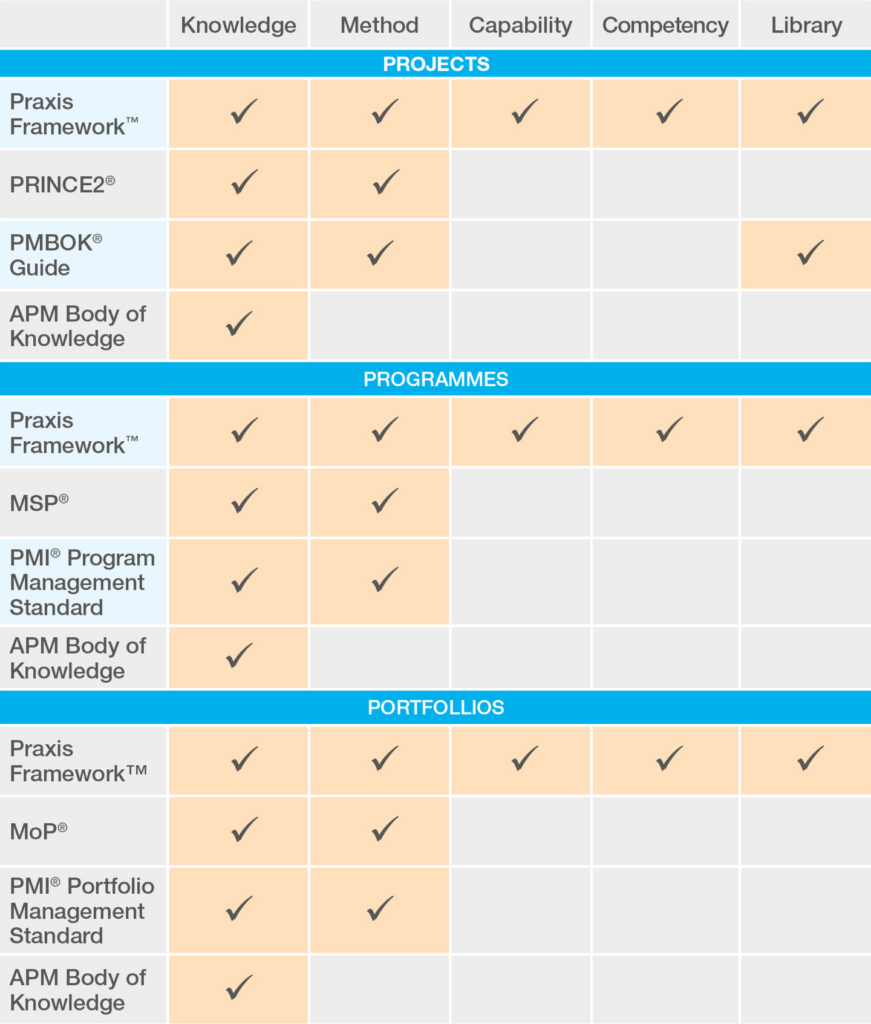
Praxis® integrates a body of knowledge, methodology, competency framework and capability maturity model into a single consistent framework. It also contains tools and resources designed to help individuals, teams and organizations improve their effectiveness and efficiency in delivering projects, programs, and portfolios.
Free
Praxis® is entirely free to use under the terms of the Creative Commons license. You may adapt and use the Praxis® Framework for your own purposes as long as you acknowledge its source. You must also make your work available to others free of royalties. Ideally, your contribution will be incorporated into its web site for the benefit of others.
Community Driven
What is unique about Praxis® is that it was put together in a community-driven way. Most project, program, and portfolio management guides are updated by panels of experts every few years. Praxis® on the other hand, aims to update and extend the framework and library on a continuous basis. As our users provide adaptations and lessons learned, these are incorporated into the framework.
Integrated
Praxis® brings together a body of knowledge, methodology, competence framework and capability maturity model in a single integrated framework with a single structure and terminology. No more need for mapping and translation between different guides.
Practical
There is no such thing as a typical project, program, or portfolio. Therefore, Praxis® is not prescriptive in the way its components are applied. The framework is designed to provide building blocks that can be tailored and assembled to suit all manner of different contexts.
Praxis is the most integrated framework in the market. The image below paints a clear picture to support this statement.
What is Praxis® Comprised of?
Praxis® provides a wealth of information. The list below provides a high-level overview of what it has to offer.
The Praxis Framework is Free
Everything Praxis has to offer is freely available at: https://www.praxisframework.org/.
Also registering to its website is free. With your membership you are able to:
The AI‑Driven Project Manager (AIPM) certification gives you the blueprint to lead that transformation to empowered decision-making, to cutting delays, to boosting ROI, and to navigate complexity with ease.
This certification equips you with the skills to leverage AI today, stay ahead of competitors, and future-proof your career.
AIPM was co-created by global experts Prof. Ricardo Vargas and Prof. Antonio Nieto-Rodriguez, and accredited by APMG International.
During an AIPM class, you’ll gain tools to reduce project overruns, improve stakeholder reporting, and elevate success rates—immediately applicable on your next project.
1. Stay Ahead in a Rapidly Evolving Field
The AIPM certification has been “recognized as one of the best AI certifications for project managers in 2025” by Digital Project Manager. This positions you at the forefront of project management evolution, ensuring you’re not left behind as AI transforms the industry.
2. Leverage World-Class Expertise
The certification is led by Prof. Antonio Nieto-Rodriguez and Prof. Ricardo Viana Vargas, PhD, who “have published over 20 books, hundreds of articles” and “delivered over 500 keynote presentations worldwide.” Both are PMI Fellows, giving you access to top-tier knowledge and proven methodologies.
3. Dramatically Improve Project Outcomes
The certification provides “knowledge and tools to leverage AI in optimizing project outcomes, enhancing decision-making processes and driving efficiency.” You’ll learn to use AI for better forecasting, risk management, and stakeholder engagement, leading to more successful projects.
4. Comprehensive AI Integration Skills
The certification covers the complete AI project lifecycle, teaching you how to seamlessly integrate AI from strategic planning through execution. You’ll learn “the AI Project Life Cycle: Navigating from problem scoping to evaluation” and real-world applications.
5. Competitive Career Advantage
The certification helps you “Stand Out Where It Counts” and positions you as “the professional who doesn’t just manage projects—but redefines how they succeed.” This differentiation is crucial in today’s competitive job market.
6. Practical, Immediately Applicable Knowledge
The training focuses on actionable skills including automating repetitive tasks, improving forecast accuracy, and using predictive analytics to anticipate risks and capitalize on opportunities. This isn’t theoretical—it’s designed for immediate implementation.
7. Broad Professional Applicability
The certification is valuable across multiple roles: Project Managers, IT Project Leaders, PMO Directors, Portfolio Managers, Program Managers, Change Managers, and Strategy Implementation Consultants. This versatility makes it a worthwhile investment regardless of your specific position.
8. Global Recognition and Standards
The certification exam is administrated by APMG International, a globally recognized certification body, the AIPM provides credible, standardized validation of your AI-driven project management skills that’s respected worldwide.
9. Future-Proof Your Career
As AI becomes mainstream in project management, this certification ensures you’re prepared for “the competitive field of project management” and positions you to lead rather than follow industry transformation.
10. Structured Learning Path
The certification offers flexible learning options including masterclasses, hands-on exercises, and certification examinations, making it accessible while maintaining rigorous standards for competency validation.
These arguments collectively demonstrate that AIPM certification is not just a credential, but a strategic career investment that provides immediate practical value while positioning professionals for long-term success in an AI-driven project management landscape.
Become a DTMethod®, Praxis®, or AIPM Coach Today
Join our team of inspiring DTMethod®, Praxis®, and AIPM Coaches
to assist business professionals with identifying, developing, and implementing innovative solutions.
Interested in becoming a trainer and/or coach?
Join our team of inspiring DTMethod®, Praxis®, and AIPM Coaches today. And guide business professionals to thrive through innovative solutions.
Find Your Perfect Course
Thrive through innovative solutions and stand out. Invest in what’s strategic and make informed decisions.
Our DTMethod®, Praxis®, and AIPM certification training programs have proven to increase revenues and team performance.
Case Study Examples
Success Stories of Organizations Practicing DTMethod’s Design Thinking